Bifold Doors vs. Sliding Doors: The Ultimate UK Homeowner's Guide
Choosing between bifold and sliding doors for your UK home? Explore design, performance, costs, and Building Regulations in this detailed comparison.

Shard Architectural Glazing
20 February 2026
Choosing between bifold and sliding doors for your UK home? Explore design, performance, costs, and Building Regulations in this detailed comparison.
📋In This Article
When planning an extension, renovation, or even just replacing existing patio doors, one of the most significant decisions homeowners face is choosing between bifold doors and sliding doors. Both options offer stunning visual appeal, flood interiors with natural light, and create a seamless connection between indoor and outdoor spaces. However, their operational mechanics, aesthetic impact, performance characteristics, and cost implications differ considerably. This comprehensive guide will delve into the nuances of each system, helping UK homeowners make an informed decision that aligns with their lifestyle, budget, and property's architectural style.
Understanding Bifold Doors
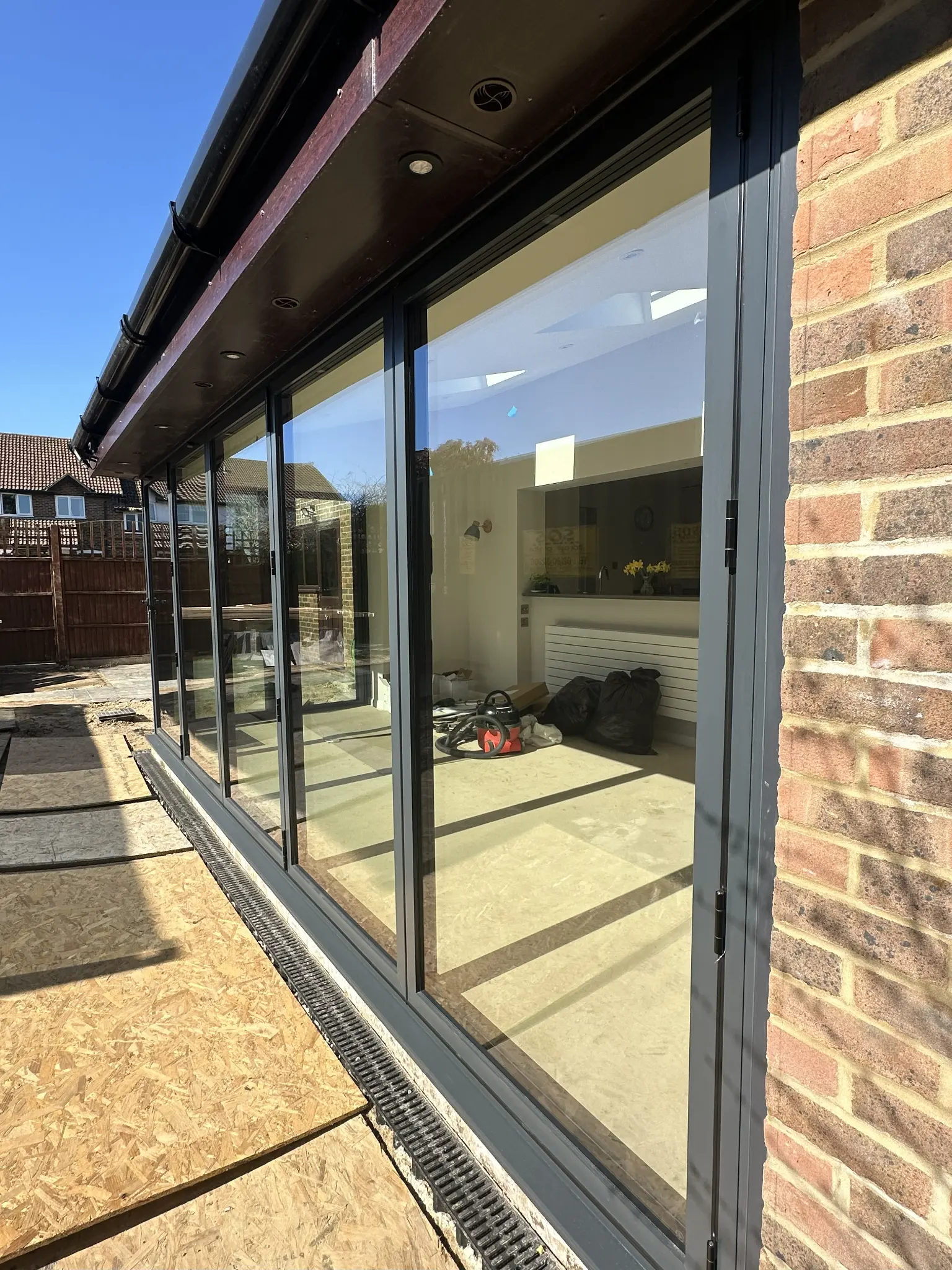
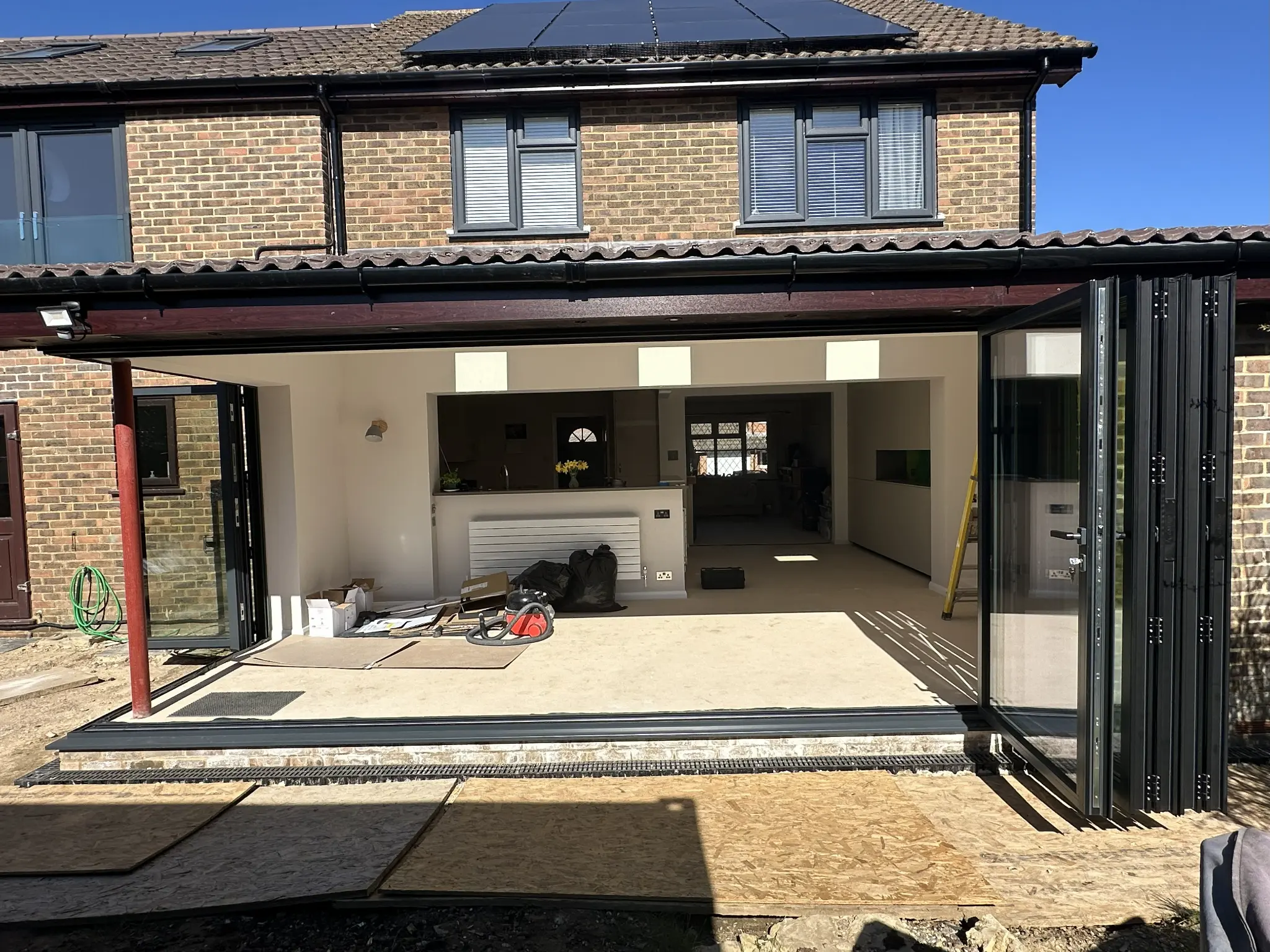
Bifold doors, also known as folding-sliding doors, consist of multiple panels that fold back concertina-style, stacking neatly to one or both sides of the opening. This mechanism allows for a near 90% clear opening, effectively blurring the lines between your home and garden.
Key Characteristics of Bifold Doors:
- Opening Mechanism: Panels are hinged together and run on a track, folding and stacking.
- Clear Opening: Offer an expansive, almost uninterrupted opening, ideal for creating large social spaces.
- Traffic Door: Often include a single 'traffic door' that can be opened independently for everyday access without folding back the entire system.
- Frame Material: Available in aluminium, uPVC, and timber. Aluminium is particularly popular for its strength, slim sightlines, and durability.
Maximum Opening
Achieve up to 90% clear opening, creating an expansive connection to the outdoors.
Seamless Transition
Ideal for entertaining, allowing large groups to move freely between spaces.
Flexible Configuration
Available in various panel numbers and opening directions to suit specific layouts.
Modern Aesthetic
Offers a contemporary, architectural look that enhances property value.
Understanding Sliding Doors
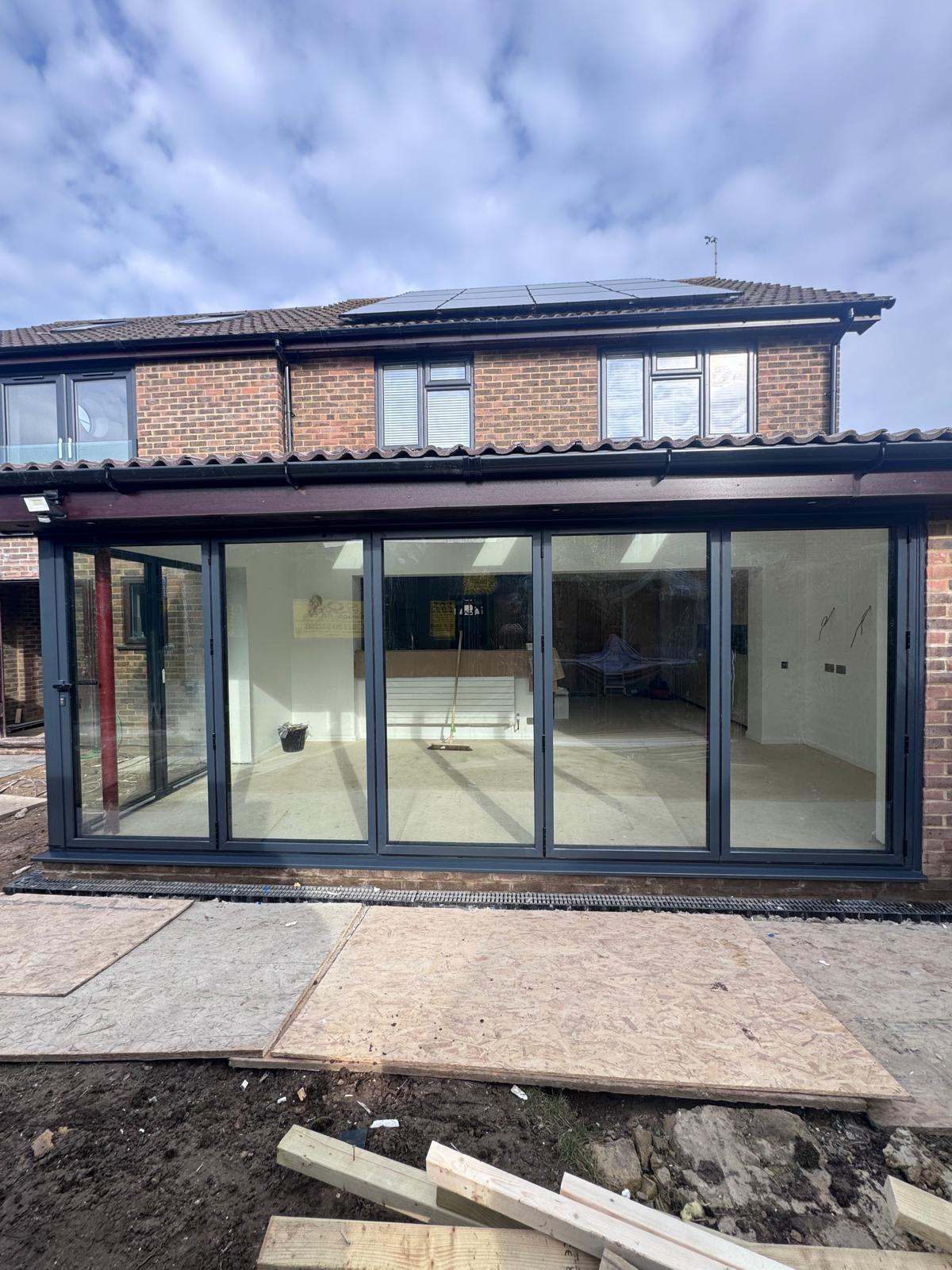
Sliding doors, often referred to as patio doors or lift-and-slide doors, feature large glass panels that slide horizontally along a track, stacking behind a fixed panel or into a wall cavity (pocket doors). They are characterised by their expansive glass areas and minimal frame presence.
Key Characteristics of Sliding Doors:
- Opening Mechanism: Panels glide past each other on a track, typically stacking behind a fixed panel. Lift-and-slide systems allow panels to be lifted slightly before sliding, improving sealing and ease of operation.
- Clear Opening: Typically offer a 50-75% clear opening, depending on the number of panels and configuration.
- Large Glass Panels: Feature fewer, larger glass panes, maximising natural light and unobstructed views.
- Frame Material: Also available in aluminium, uPVC, and timber, with aluminium being favoured for its ability to support very large glass units with slim frames.
Pro Tip
Consider the 'stacking space' for both door types. Bifold doors require space for the folded panels, which can encroach on patio or internal areas. Sliding doors require space for panels to stack behind each other, which is usually less intrusive but means a portion of the opening is always covered by glass.
Performance and Technical Considerations
Beyond aesthetics, the practical performance of your chosen door system is paramount, especially regarding energy efficiency, security, and durability.
Energy Efficiency (U-Values):
In the UK, compliance with Building Regulations Part L (Conservation of Fuel and Power) is crucial. For windows and doors, this is measured by the U-value, which indicates how well a component prevents heat from escaping. A lower U-value signifies better insulation.
- New Build Properties: Windows and doors must achieve a maximum U-value of 1.2 W/m²K.
- Replacement Windows/Doors: Must achieve a maximum U-value of 1.4 W/m²K.
Both bifold and sliding doors can meet these requirements, but it's essential to specify high-performance glazing (e.g., argon-filled double or triple glazing with low-emissivity coatings) and thermally broken frames. Sliding doors, with their larger glass-to-frame ratio, can sometimes achieve slightly better overall U-values for a given frame material, as glass is generally a better insulator than frame material.
Security:
Modern bifold and sliding doors are designed with robust security features. Look for:
- Multi-point locking systems: Engaging at several points along the frame.
- Internal glazing beads: Preventing glass removal from the outside.
- Anti-lift mechanisms: Preventing panels from being dislodged from their tracks.
- Laminated or toughened glass: Enhancing resistance to impact.
- Accreditation: Doors certified to PAS 24:2016 (Enhanced Security Performance Requirements for Doorsets and Windows in the UK) offer superior protection.
Weather Sealing and Durability:
Both door types use advanced gaskets and seals to prevent draughts and water ingress. Sliding doors, particularly lift-and-slide systems, often excel in weather sealing due to their simpler panel configuration and the ability of panels to drop onto seals when closed. Bifolds have more moving parts and more sealing points, which, if not meticulously installed and maintained, could potentially be areas of weakness over time.
Design, Aesthetics, and Functionality
The visual impact and daily usability are key decision-makers.
Aesthetic Appeal:
- Bifold Doors: Offer a dynamic, architectural statement. When open, they create an unparalleled connection to the outdoors. When closed, the multiple vertical lines of the frames can be a prominent design feature.
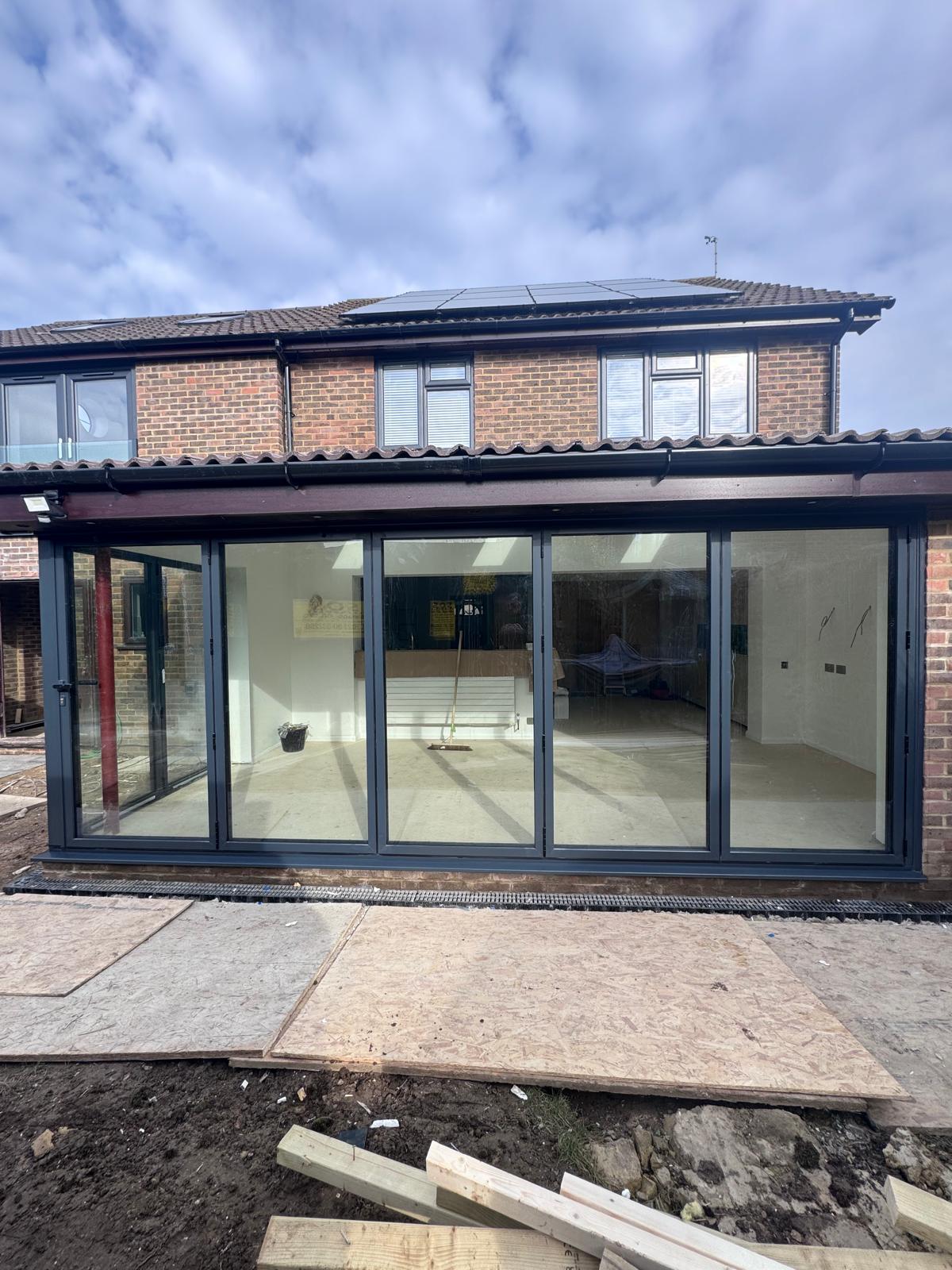
- Sliding Doors: Provide a sleek, minimalist look with expansive, uninterrupted glass panels. They offer panoramic views and allow maximum light penetration, even when closed. The fewer, larger panes create a 'wall of glass' effect.
Operation and Usability:
- Bifold Doors: Require more effort to open fully as all panels must be folded. However, the traffic door provides convenient everyday access. They can be susceptible to strong winds when fully open.
- Sliding Doors: Easy to operate, with panels gliding smoothly. They don't project outwards or inwards, saving space. They are generally more stable in windy conditions as panels remain within the frame.
Space Considerations:
- Bifold Doors: The stacked panels will occupy space at the side of the opening, either internally or externally. This needs to be factored into patio or room design.
- Sliding Doors: Panels stack parallel to each other, meaning they don't intrude on living space or patio areas. This can be a significant advantage in smaller spaces.
Cost and Installation
The total cost will vary significantly based on material, size, glazing specification, and installation complexity.
Material Costs (General Guide):
- uPVC: Generally the most budget-friendly option for both types.
- Aluminium: Mid-to-high range, offering superior strength, durability, and slim sightlines.
- Timber: Often the most expensive, requiring more maintenance but providing a classic, natural aesthetic.
Bifold Door Costs:
Typically, bifold doors can be more expensive per linear metre than sliding doors due to their more complex hardware and greater number of moving parts. Installation can also be more intricate.
Sliding Door Costs:
While individual large sliding panels can be costly, the overall system might be more economical for a given opening width, especially with fewer panels. Lift-and-slide mechanisms add to the cost but significantly improve performance.
Installation:
Both systems require a perfectly level and square opening to function correctly and prevent issues like sticking or poor weather sealing. Professional installation by experienced fitters is highly recommended. The structural integrity of the opening must also be assessed, as large door systems can exert significant loads.
UK Building Regulations and Planning
Any significant alteration to your home, including installing new or replacement doors of a different size or type, will likely fall under UK Building Regulations. While replacing existing doors with similar ones often falls under permitted development, it is always advisable to check with your local authority's Building Control department.
Key Regulations to Consider:
- Part L (Conservation of Fuel and Power): As mentioned, U-values are critical. Ensure your chosen doors meet the current standards (1.2 W/m²K for new builds, 1.4 W/m²K for replacements).
- Part F (Ventilation): New doors may need to incorporate trickle vents to ensure adequate background ventilation, especially if they replace older, less airtight units.
- Part K (Protection from Falling, Collision and Impact): Glazing must be of a safe type (e.g., toughened or laminated glass) in critical locations to prevent injury.
- Part B (Fire Safety): Less common for external doors, but relevant if the doors are near a boundary or form part of a fire escape route.
For new extensions, the entire extension's thermal performance will be assessed. The U-values for other elements are:
- Walls: 0.18 W/m²K
- Floors: 0.18 W/m²K
- Roofs: 0.15 W/m²K
Always consult with Building Control or a qualified architect/builder early in your project to ensure full compliance. Failure to comply could affect future property sales.
Comparison Table: Bifold vs. Sliding Doors
| Feature | Bifold Doors | Sliding Doors |
|---|---|---|
| Clear Opening | Up to 90% | 50-75% |
| Views (when closed) | More vertical frames, segmented views | Fewer, larger panes, panoramic views |
| Space Usage (when open) | Panels stack inwards or outwards, requiring space | Panels slide parallel, saving space |
| Everyday Access | Often includes a convenient 'traffic door' | Requires sliding a panel, no independent door |
| Aesthetic | Dynamic, architectural, contemporary | Sleek, minimalist, 'wall of glass' effect |
| Security | Multi-point locking on all panels, PAS 24 options | Multi-point locking, anti-lift, PAS 24 options |
| Weather Sealing | Excellent with modern seals, more sealing points | Often superior, especially lift-and-slide systems |
| Cost (general) | Can be higher due to complex hardware | Potentially more cost-effective for large openings |
| Building Regs (U-value) | Min. 1.2 W/m²K (new), 1.4 W/m²K (replacement) | Min. 1.2 W/m²K (new), 1.4 W/m²K (replacement) |
Making Your Final Decision
The choice between bifold and sliding doors ultimately depends on your priorities:
- If maximising the open space and creating an almost completely unobstructed link to your garden is your top priority, bifold doors are likely the better choice.
- If you value uninterrupted panoramic views, a sleek minimalist aesthetic, and space-saving operation, sliding doors (especially large-format or lift-and-slide) will be more appealing.
- Consider your budget, the architectural style of your home, and how you intend to use the space daily.
It's highly recommended to visit showrooms to experience both door types firsthand. Operate them, feel the quality of the mechanisms, and visualise how they would integrate into your home. Discuss your specific requirements with reputable suppliers who can provide expert advice on materials, glazing options, and compliance with UK Building Regulations.
At Shard AG, we specialise in high-performance architectural glazing solutions for UK homeowners. Our expert team can guide you through the selection process for both bifold and sliding doors, ensuring you choose a system that perfectly complements your home's design and meets all necessary performance and regulatory standards. We offer a range of premium aluminium systems, renowned for their durability, thermal efficiency, and stunning aesthetics. Contact us today for a consultation and discover how we can transform your living space.
Explore Our Products
Discover how Shard Architectural Glazing can transform your home with our premium glazing solutions:
Ready to Transform Your Home?
Get in touch with our expert team for a free consultation and personalised quote. We'll help you choose the perfect glazing solution for your property.