Bifold Doors vs. Sliding Doors: A UK Homeowner's Guide
Explore the differences between bifold and sliding doors for your UK home. Understand design, performance, costs, and Building Regulations compliance.

Shard Architectural Glazing
21 February 2026
Explore the differences between bifold and sliding doors for your UK home. Understand design, performance, costs, and Building Regulations compliance.
📋In This Article
Choosing the right large-format glazing for your home can dramatically transform its aesthetic, functionality, and connection to the outdoors. For many UK homeowners, the decision often comes down to two popular options: bifold doors and sliding patio doors. Both offer expansive views and seamless transitions, but they achieve this through distinct mechanisms and come with their own set of advantages and considerations. This comprehensive guide will delve into the technical aspects, practical implications, and regulatory requirements to help you make an informed decision for your property.
Design and Operation: How They Differ
While both door types aim to open up a wall, their fundamental operation is quite different, leading to varied aesthetic and functional outcomes.
Bifold Doors (Folding-Sliding Doors)
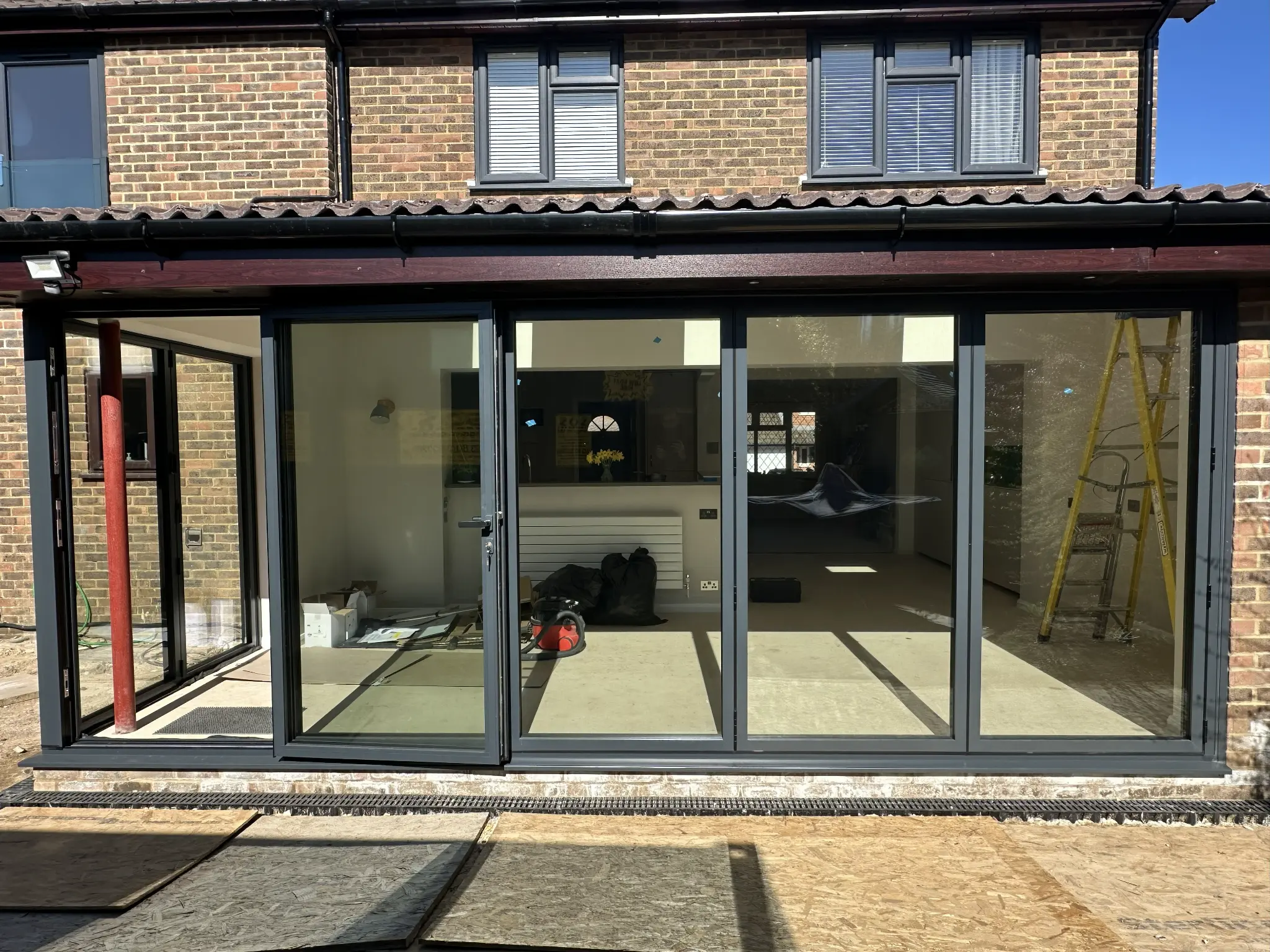
Bifold doors consist of multiple panels that fold back concertina-style, stacking neatly to one or both sides of the opening. Each panel is typically hinged to the next, with a lead door that operates like a traditional hinged door, allowing for easy access without opening the entire system. The panels run on a track, usually top-hung or bottom-rolling, and fold outwards or inwards.
- Mechanism: Panels fold and stack, creating a wide, unobstructed opening.
- Frame: Generally feature more vertical sightlines due to the individual panels and hinges.
- Opening: Can achieve up to 90-95% clear opening, depending on the configuration and stacking space.
- Configurations: Highly versatile, with options for odd or even numbers of panels, opening in one direction or split, and with or without a traffic door.
Sliding Patio Doors (Lift & Slide or Inline)
Sliding doors, often referred to as patio doors, consist of large glass panels that slide horizontally past one another within a fixed frame. Modern sliding doors often utilise a 'lift and slide' mechanism, where the door panel is slightly lifted off its seals before sliding, providing superior weather sealing and smoother operation. Inline sliding doors simply slide along a track.
- Mechanism: Panels glide parallel to each other, stacking behind a fixed panel or another sliding panel.
- Frame: Typically feature fewer, larger glass panels, resulting in fewer vertical sightlines and a more expansive, uninterrupted view when closed.
- Opening: Usually achieve a 50-75% clear opening, as at least one panel will always remain fixed or cover another.
- Configurations: Common options include two, three, or four panels, with one or more panels sliding. Corner configurations are also possible.
Pro Tip
Consider the 'traffic door' functionality. Bifold doors often incorporate a single hinged panel for everyday access without opening the entire system. With sliding doors, you'll need to slide a panel open, which might be less convenient for quick trips outside.
Thermal Performance and Building Regulations
For any new or replacement glazing in the UK, compliance with Part L (Conservation of Fuel and Power) of the Building Regulations 2022 (England) is crucial. This mandates specific U-values (thermal transmittance) to ensure energy efficiency.
U-Values Explained
A U-value measures how effectively a material prevents heat from passing through it. The lower the U-value, the better the insulation. It is measured in Watts per square metre Kelvin (W/m²K).
Current UK Building Regulations Part L (2022 England) for Glazing:
- New Build Homes: Windows and doors must achieve a maximum U-value of 1.2 W/m²K.
- Existing Homes (Replacement Glazing): Replacement windows and doors must achieve a maximum U-value of 1.4 W/m²K.
Both bifold and sliding doors can be manufactured to meet these stringent requirements, typically through:
- Double or Triple Glazing: Low-emissivity (low-e) glass, often with inert gas (like argon) filled cavities.
- Thermally Broken Frames: Aluminium frames, common for both door types, must incorporate a 'thermal break' – a non-conductive material separating the inner and outer parts of the frame to prevent heat transfer.
- High-Performance Seals: Effective weather seals are vital to prevent draughts and water ingress.
When selecting your doors, always request the U-value specification for the complete door set (frame and glass) to ensure compliance. Failure to meet these standards could affect compliance with Building Control and potentially impact the energy efficiency of your home.
Cost and Maintenance Considerations
The initial outlay and ongoing care are significant factors in any home improvement project.
Cost
Generally, bifold doors tend to be more expensive per linear metre than sliding doors. This is due to the more complex hardware involved – multiple hinges, more intricate tracking systems, and often more labour-intensive manufacturing. However, prices vary significantly based on:
- Material: Aluminium is popular for both due to its strength, durability, and slim sightlines. Timber and uPVC are also options.
- Size: Larger openings naturally cost more.
- Glazing Specification: Double vs. triple glazing, low-e coatings, and gas fills.
- Hardware: Quality of hinges, rollers, and locking mechanisms.
- Installation: Professional installation is crucial for proper operation and longevity.
Maintenance
Both door types are relatively low maintenance, particularly those with aluminium frames. Regular cleaning of glass and frames is usually sufficient. However, consider these specifics:
- Bifold Doors: The multiple moving parts (hinges, rollers, tracks) may require occasional lubrication and inspection to ensure smooth operation. Keep tracks clear of debris.
- Sliding Doors: Generally simpler mechanics, meaning fewer points of potential wear. Tracks should be kept clean to prevent grit from impeding smooth sliding. Lift and slide mechanisms are robust but benefit from occasional checks.
Advantages and Disadvantages: A Comparison
Here's a balanced look at the pros and cons of each system:
Bifold Doors: Pros
Maximum Opening: Offer the largest unobstructed opening, truly blurring the lines between indoors and out.
Bifold Doors: Cons
Stacking Space: Require space for panels to stack, which can intrude on patio or internal space.
Sliding Doors: Pros
Uninterrupted Views: Fewer, larger panels provide expansive, panoramic views even when closed.
Sliding Doors: Cons
Limited Opening: Never achieve a full 100% opening, as panels always overlap or stack behind others.
| Feature | Bifold Doors | Sliding Doors |
|---|---|---|
| Clear Opening | Up to 90-95% | 50-75% |
| View When Closed | More vertical sightlines (frames, hinges) | Fewer, larger panels; expansive, panoramic |
| Space Requirement | Need stacking space at ends | Panels slide within footprint, no external stack |
| Operation | Folding, concertina action | Horizontal gliding action |
| Hardware Complexity | More complex (multiple hinges, rollers) | Simpler (fewer, larger rollers/tracks) |
| Typical Cost | Generally higher | Generally lower |
| Aesthetics | Dynamic, engaging when open | Sleek, minimalist, ideal for modern designs |
| Ventilation | Can open fully for maximum airflow | Limited to the width of the open panel |
| Security | Multi-point locking on all panels | Multi-point locking on sliding panels |
Security and Weather Resistance
Modern bifold and sliding doors are designed with security and weather resistance as top priorities, but there are nuances.
Security
Both door types should feature multi-point locking systems, securing the panels at several points along the frame. Look for doors that meet PAS 24:2016, the UK standard for enhanced security performance of doors and windows. Key features include:
- Cylinder Locks: High-security cylinders (e.g., 3-star rated) resistant to picking, drilling, and bumping.
- Internal Glazing Beads: Glass should be internally beaded, meaning it can only be removed from inside the property, preventing external removal by intruders.
- Robust Frames: Strong aluminium frames offer inherent rigidity.
Bifold doors have more individual panels and therefore more locking points, which can be seen as an advantage. Sliding doors, with fewer panels, rely on robust locking mechanisms on the sliding panels and strong interlocks where panels meet.
Weather Resistance
The UK climate demands doors that can withstand wind, rain, and cold. Both types of doors are rigorously tested to British Standards for:
- Air Permeability (BS EN 12207): Resistance to air leakage.
- Water Tightness (BS EN 12208): Resistance to water penetration.
- Wind Resistance (BS EN 12210): Ability to withstand wind loads.
High-quality doors will feature effective EPDM rubber gaskets and seals, along with intelligent drainage systems. Lift and slide mechanisms on sliding doors are particularly effective at creating a tight seal when closed, as the panels drop down onto the weather seals.
Installation and Structural Considerations
Proper installation is paramount for the long-term performance and safety of large glazing systems.
Structural Opening
Regardless of the door type, creating a large opening in an external wall will almost certainly require the installation of a new lintel or steel beam (RSJ) to support the structure above. This work is structural and falls under the purview of Building Regulations. You will need to:
- Obtain a structural engineer's calculations for the required beam size.
- Submit a Building Notice or Full Plans application to your local Building Control body before work commences.
- Ensure the work is inspected by Building Control at key stages and obtain a completion certificate.
Thresholds
- Low Thresholds: Both door types can be installed with low or flush thresholds, creating a seamless transition between indoor and outdoor spaces. However, flush thresholds require careful consideration of drainage to prevent water ingress, especially in exposed locations.
- Weathered Thresholds: A slightly raised, weathered threshold offers superior protection against the elements, often a pragmatic choice for the UK climate, particularly in exposed areas.
Making Your Decision
The choice between bifold and sliding doors ultimately comes down to your priorities and the specific characteristics of your home and lifestyle. Consider these questions:
- How important is a 100% clear opening? If you want to completely open up the space, bifolds are superior.
- Do you prioritise uninterrupted views when the doors are closed? Sliding doors, with their fewer, larger panels, offer a more panoramic vista.
- What is your budget? Sliding doors are generally more budget-friendly.
- How much space do you have on your patio or indoors for stacking panels? Bifolds require this space; sliding doors do not.
- What is the architectural style of your home? Bifolds can suit various styles, while the minimalist aesthetic of sliding doors often complements contemporary designs.
- What are your ventilation needs? Bifolds offer maximum airflow when fully open.
It's highly recommended to visit showrooms to see both types of doors in operation, feel their quality, and discuss your specific requirements with experienced suppliers. They can provide detailed specifications, U-values, and advice on Building Regulations compliance for your project.
At Shard AG, we specialise in providing high-performance architectural glazing solutions for UK homeowners. Our expert team can guide you through the selection process, offering a range of premium bifold and sliding door options designed to meet the latest Building Regulations and enhance your home's energy efficiency, security, and aesthetic appeal. Contact us today to discuss your project and discover how we can help bring your vision to life.
Explore Our Products
Discover how Shard Architectural Glazing can transform your home with our premium glazing solutions:
Ready to Transform Your Home?
Get in touch with our expert team for a free consultation and personalised quote. We'll help you choose the perfect glazing solution for your property.